· Ch. Umar · Industrial · 3 min read
Dry Ice Blasting vs Pressure Washing - Industrial Cleaning Comparison for Pakistan
Dry ice blasting uses CO2 pellets to clean machinery without water, chemicals, or abrasives. Pressure washing uses high-pressure water. Learn which is right for Pakistani factories.
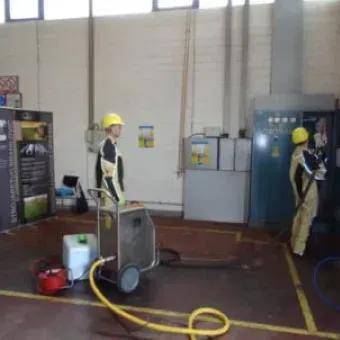
Dry ice blasting cleans industrial machinery using 3mm CO2 pellets at high velocity, producing zero liquid residue and no secondary waste. Pressure washing uses high-pressure water jets, generating large volumes of contaminated wastewater. For Pakistan’s textile, food processing, and electronics industries, dry ice blasting is the technically superior choice for machinery that cannot tolerate moisture.
How Dry Ice Blasting Works
Dry ice blasting uses compressed air to accelerate 3mm food-grade CO2 pellets at high velocity against a surface. The cleaning mechanism involves three simultaneous actions:
Kinetic Energy Impact
Pellets travelling at high velocity create a mechanical impact that fractures and dislodges contamination layers from the surface - similar to sandblasting, but without abrasion to the base material.
Thermal Shock Effect
At -78.5°C, pellets create an instantaneous extreme cold shock on contact with the warm surface. This thermal differential causes contamination coatings to crack and separate from the substrate.
CO2 Sublimation Expansion
As pellets penetrate between the contamination layer and the base surface, they sublimate, expanding 800 times in volume. This explosive expansion lifts contamination particles off the surface.
How Pressure Washing Works
Pressure washing directs water at pressures between 1,000 and 4,000 PSI through a nozzle. The high-velocity water impact mechanically dislodges contamination from surfaces. It requires no specialised gas, but generates large volumes of contaminated wastewater.
Key Comparison - Dry Ice Blasting vs Pressure Washing
| Factor | Dry Ice Blasting | Pressure Washing |
|---|---|---|
| Water usage | Zero | 15–50 litres/min |
| Secondary waste | Zero (CO2 gas) | Contaminated wastewater |
| Electrical equipment safe | Yes | No |
| Food equipment safe | Yes (food-grade CO2) | Depends on water quality |
| Abrasion to surface | Zero | Low–Medium |
| Can clean in-situ | Yes (no disassembly) | Often requires disassembly |
| Pakistan utility cost | Moderate (CO2 pellets) | Low (water/electricity) |
When Pakistani Factories Should Use Dry Ice Blasting
Faisalabad Textile Machinery
Looms, printing rollers, and dyeing equipment in Faisalabad’s textile mills accumulate dye residue, oil deposits, and fibre lint. Water cannot be used on electrical components or fine mechanical parts. Dry ice blasting cleans all surfaces without stopping the production line or creating wastewater disposal challenges.
Karachi Food Processing Equipment
Food processing machinery - conveyors, mixing equipment, and packaging lines - must be cleaned without chemical residues or water contamination. Dry ice blasting with food-grade CO2 pellets is the only cleaning method that achieves this without equipment disassembly.
Karachi Automotive and Electronics Factories
Electrical panels, circuit boards, and automotive assembly equipment cannot be cleaned with water. Dry ice blasting removes oil, grease, and particulate deposits without any moisture, making it safe for active electrical and electronic components.
When Pressure Washing is Appropriate in Pakistan
Pressure washing is appropriate for:
- Exterior concrete surfaces, car parks, and warehouse floors
- Outdoor equipment with no electrical components
- Vehicles and heavy construction machinery
- Situations where wastewater disposal is not a regulatory concern
Order Dry Ice Pellets for Industrial Blasting in Pakistan
DRY ICE PAKISTAN supplies 3mm high-density dry ice pellets specifically for use in industrial CO2 blasting machines across Pakistan. Bulk supply is available for factories in Faisalabad, Karachi, Lahore, and Rawalpindi.
WhatsApp: +92 334 0033328 for industrial pricing and scheduled delivery contracts.
Need Dry Ice in Pakistan?
DRY ICE PAKISTAN supplies premium food-grade pellets and blocks for all industrial, medical, and event applications. We offer nationwide delivery with same-day dispatch in Rawalpindi, Islamabad, and Lahore.
Contact Us Today or message us on WhatsApp at +92 334 0033328.